 EN
ENPages

1
Historic, Archive Document Do not assume content reflects current scientific knowledge, policies, or practices.

3
USDA United States Department of Agriculture
Attracting Hummingbirds to Your Garden Using Native Plants Reserve
aQL.636 .R558A87 2015
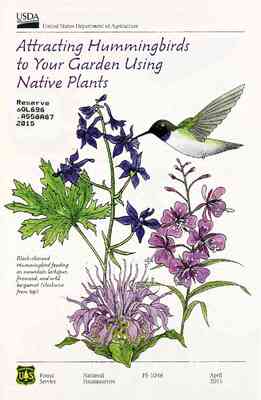
Black-chinned H ummingbird feeding on mountain larkspur, fireweed, and wild bergamot (clockwise from top)
Forest Service
National Headquarters
FS-1046
April 2015
4
This page is not corrected, please help correct this page
5
Hummingbirds and pollination
At rest, a hummer’s heart beats an average of 480 beats per minute. On cold nights, it goes into torpor (hibernation¬ like state), and its heart rate drops to 45 to 180 beats per minute.
Flowers and hummingbirds have a mutualistic relationship where both benefit. Flowers produce food in the form of nectar (sugar and water) to attract hummingbirds that, in turn, move pollen for the plant (pollination).
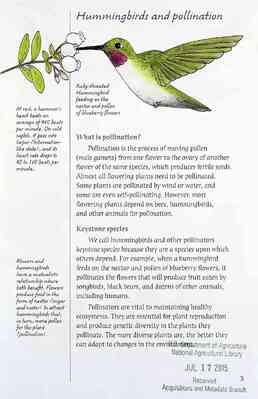
Ruby-throated Hummingbird feeding on the nectar and pollen of blueberry flowers
What is pollination?
Pollination is the process of moving pollen (male gamete) from one flower to the ovary of another flower of the same species, which produces fertile seeds. Almost all flowering plants need to be pollinated. Some plants are pollinated by wind or water, and some are even self-pollinating. However, most flowering plants depend on bees, hummingbirds, and other animals for pollination.
Keystone species We call hummingbirds and other pollinators keystone species because they are a species upon which others depend. For example, when a hummingbird feeds on the nectar and pollen of blueberry flowers, it pollinates the flowers that will produce fruit eaten by songbirds, black bears, and dozens of other animals, including humans. Pollinators are vital to maintaining healthy ecosystems. They are essential for plant reproduction and produce genetic diversity in the plants they pollinate. The more diverse plants are, the better they can adapt to changes in the environment.